Book Guide
ml4t-models is the library form of the model families developed manually in the book notebooks.
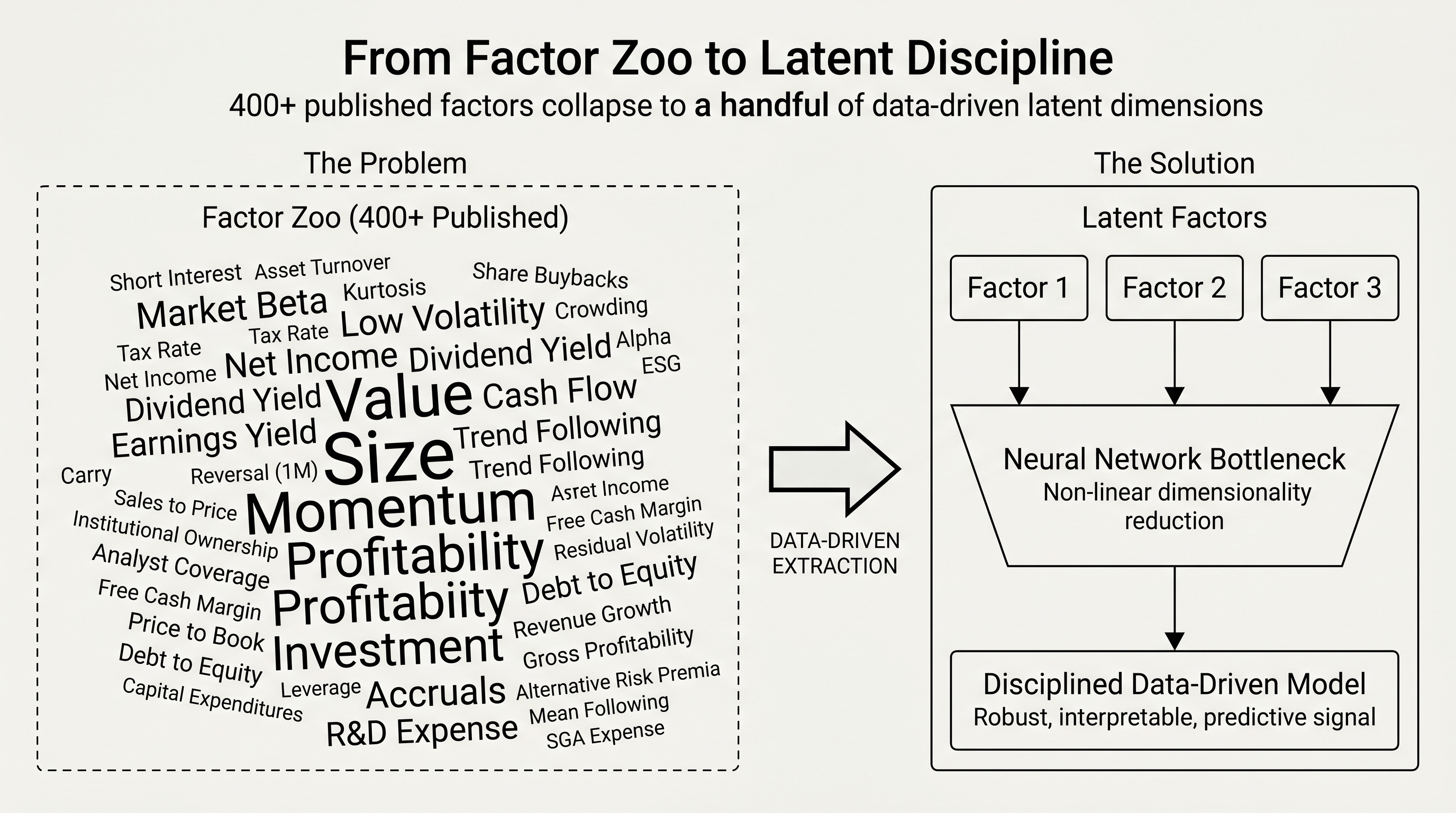
The goal is not to hide the teaching implementation. The goal is to:
- show the architecture and mathematics clearly in the chapter notebooks
- use the library for repeatable case-study execution and downstream integration
Chapter Mapping
Chapter 14: Latent Factors
The latent-factor chapter corresponds most directly to:
PCAModelRPPCAModelIPCAModelCAEModelStochasticDiscountFactorModelSAEModelas supervised autoencoder direct prediction
The key conceptual transition from the notebooks to the library is:
- notebook exposition may derive the math and architecture step by step
- library code enforces the clean separation between:
- structural extraction
- factor forecasting
- asset mapping
That separation matters most for IPCAModel and CAEModel. In the teaching notebooks, it
is helpful to show the full architecture and fitted-return logic step by step. In the
library, the corresponding production object is the two-step pipeline:
Chapter 17: Portfolio Construction
The end-to-end allocation family corresponds to:
LinearFeaturePortfolioModelLSTMPortfolioModelDeepPortfolioModel
These models are designed to connect naturally to:
- Chapter 18 cost modeling
- Chapter 19 risk controls
- Chapter 20 strategy analysis
Why The Library Split Matters
The book often needs to compare multiple modeling ideas side by side:
- latent-factor models
- no-arbitrage SDF models
- direct signal models
- end-to-end allocation models
The library turns those into explicit families instead of treating them as one generic “deep learning model.”
Case Studies
The case studies are intended to act as:
- integration tests
- realistic pressure tests for the API
- examples of how to hand model outputs into
ml4t-backtestandml4t-diagnostic
They should not define the public API by accident.
Compatibility Status
The 0.1.0 stable line is validated against the Chapter 14 teaching flow and the shared case-study
latent-factor bridge.
| Book surface | Validation status |
|---|---|
14_latent_factors/04_ipca.ipynb |
full notebook execution passed |
14_latent_factors/05_rp_pca.ipynb |
full notebook execution passed |
14_latent_factors/06_conditional_autoencoder.ipynb |
full notebook execution passed |
14_latent_factors/07_stochastic_discount_factor.ipynb |
full notebook execution passed |
14_latent_factors/08_supervised_autoencoder.ipynb |
Papermill smoke execution passed; full production training is long-running |
14_latent_factors/09_case_study_insights.ipynb |
full notebook execution passed |
case_studies.utils.latent_factors.library_bridge |
synthetic PCA, IPCA, CAE, SAE, and SDF bridge smoke checks passed |
The teaching notebooks keep hand-built implementations where that improves exposition. The
case-study path uses ml4t-models through the shared latent-factor bridge so the same
contracts are exercised in walk-forward validation and registry-backed analysis.
Case-Study Validation
The beta gate also checks that each case-study family can execute its model-specific latent-factor notebooks through the shared bridge.
| Case study | Validation status |
|---|---|
| ETF returns | PCA, IPCA, SDF, and SAE cached executions passed; CAE passed in cached three-fold validation mode |
| US firm characteristics | IPCA, CAE, SDF, and SAE passed in cached three-fold validation mode |
| S&P 500 option analytics | PCA, IPCA, CAE, SDF, and SAE passed in cached three-fold validation mode |
The ETF CAE notebook also reached the cached full-fold execution path and loaded the registry-backed model outputs before the notebook kernel exited while processing the large cached result set. The three-fold validation run exercises the same library bridge, checkpoint handling, prediction schema, and registry persistence path with a bounded runtime footprint.
Evaluation Boundary
Case-study IC reporting is delegated to ml4t-diagnostic:
- fold-level scoring calls
ml4t.diagnostic.metrics.cross_sectional_ic - pooled model-analysis summaries call
cross_sectional_icandcross_sectional_ic_series - model outputs are converted into
PredictionsFrame,SignalsFrame,WeightsFrame, andml4t-backtesthandoff payloads by library adapters
ml4t-models remains responsible for fitting and output contracts. Statistical diagnostics
and execution simulation remain owned by ml4t-diagnostic and ml4t-backtest.
Recommended Reading Order
If you are moving from the book notebooks to the library: