Latent-Factor Models
This guide covers the structural latent-factor family:
PCAModelRPPCAModelIPCAModelCAEModel
These models all estimate latent structure, but they do not all use the same data contract or economic assumptions.
The family splits into two groups:
- persistent-panel estimators:
PCAModel,RPPCAModel - dated cross-sectional estimators:
IPCAModel,CAEModel
Overview
| Model | Input contract | Native output | Main assumption | Predictive object |
|---|---|---|---|---|
PCAModel |
PersistentPanelBatch |
LatentFactorState with static loadings and factor returns |
stable asset IDs | beta × premium after a forecaster |
RPPCAModel |
PersistentPanelBatch |
LatentFactorState with pricing-aware static loadings |
stable asset IDs and meaningful cross-sectional means | beta × premium after a forecaster |
IPCAModel |
CrossSectionBatch |
LatentFactorState with characteristic-implied betas |
dated characteristics parameterize conditional exposures | beta × premium after a forecaster |
CAEModel |
CrossSectionBatch |
LatentFactorState with nonlinear characteristic betas |
nonlinear exposure map can be learned from cross-sections | beta × premium after a forecaster |
PCA
PCAModel is the persistent-panel baseline.
Use it when:
- entity identity is stable through time
- variance decomposition is the primary structural task
- a simple low-dimensional baseline is more important than pricing-aware extraction
It estimates:
- static loadings
- factor returns from demeaned panel returns
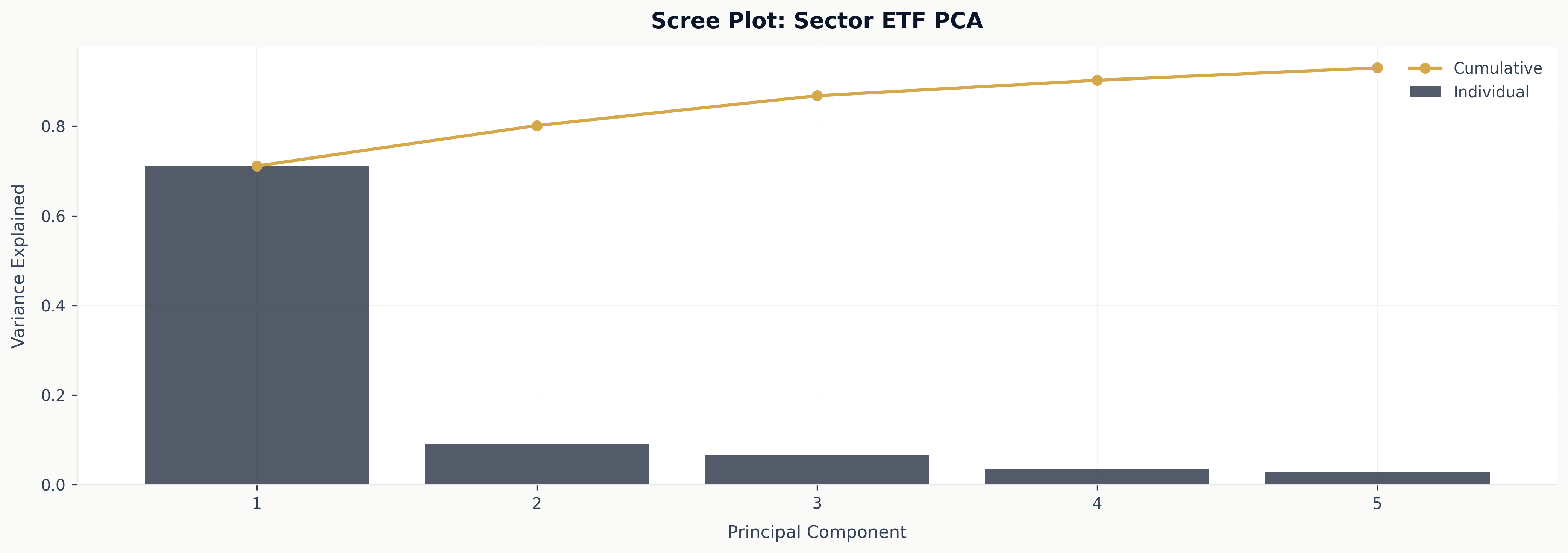
It does not directly forecast expected returns. That requires:
- a factor-premium forecast
- an asset mapper
Do not use PCA when the asset axis is an unstable identifier field. PCA and RP-PCA rely on the same entity occupying the same panel slot through time.
RP-PCA
RPPCAModel extends PCA by letting expected-return information influence factor extraction.
Conceptually, it moves from:
- explaining covariance only
to:
- explaining covariance and cross-sectional mean differences
This makes it attractive when you want factors that matter for pricing rather than only for variance decomposition.
The model follows Lettau and Pelger (2020): the extraction criterion blends covariance structure with pricing information instead of treating those as separate downstream concerns.
Key config fields:
gammabase_momentscale_by_asset_volatilitynormalize_loadingsorthogonalize_factors
The gamma parameter in RPPCAConfig is the RP-PCA pricing-error weight, not an exposure
matrix. The fitted loadings are returned in LatentFactorState.asset_betas.
IPCA
IPCAModel is the linear bridge between PCA and neural conditional factor models.
Economic idea:
- asset loadings are not static
- they are linear functions of observable characteristics
In the library, IPCAModel:
- consumes
CrossSectionBatch - alternates between factor estimation and gamma estimation
- returns a
LatentFactorStatewith conditional betas and factor history - reports ALS convergence metadata in
LatentFactorState.metadata
The economic interpretation follows Kelly, Pruitt, and Su (2019): characteristics do not predict returns directly in an unconstrained way. They parameterize conditional factor exposures.
Predictive use:
- forecast factor premia from historical factor returns
- map current conditional betas times those premia back to assets
CAE
CAEModel is a conditional autoencoder structural extractor.
It should be interpreted as:
- a nonlinear extension of IPCA
- not as a direct supervised return predictor
The model learns:
- a nonlinear mapping from characteristics to betas
- latent factor returns from managed portfolios
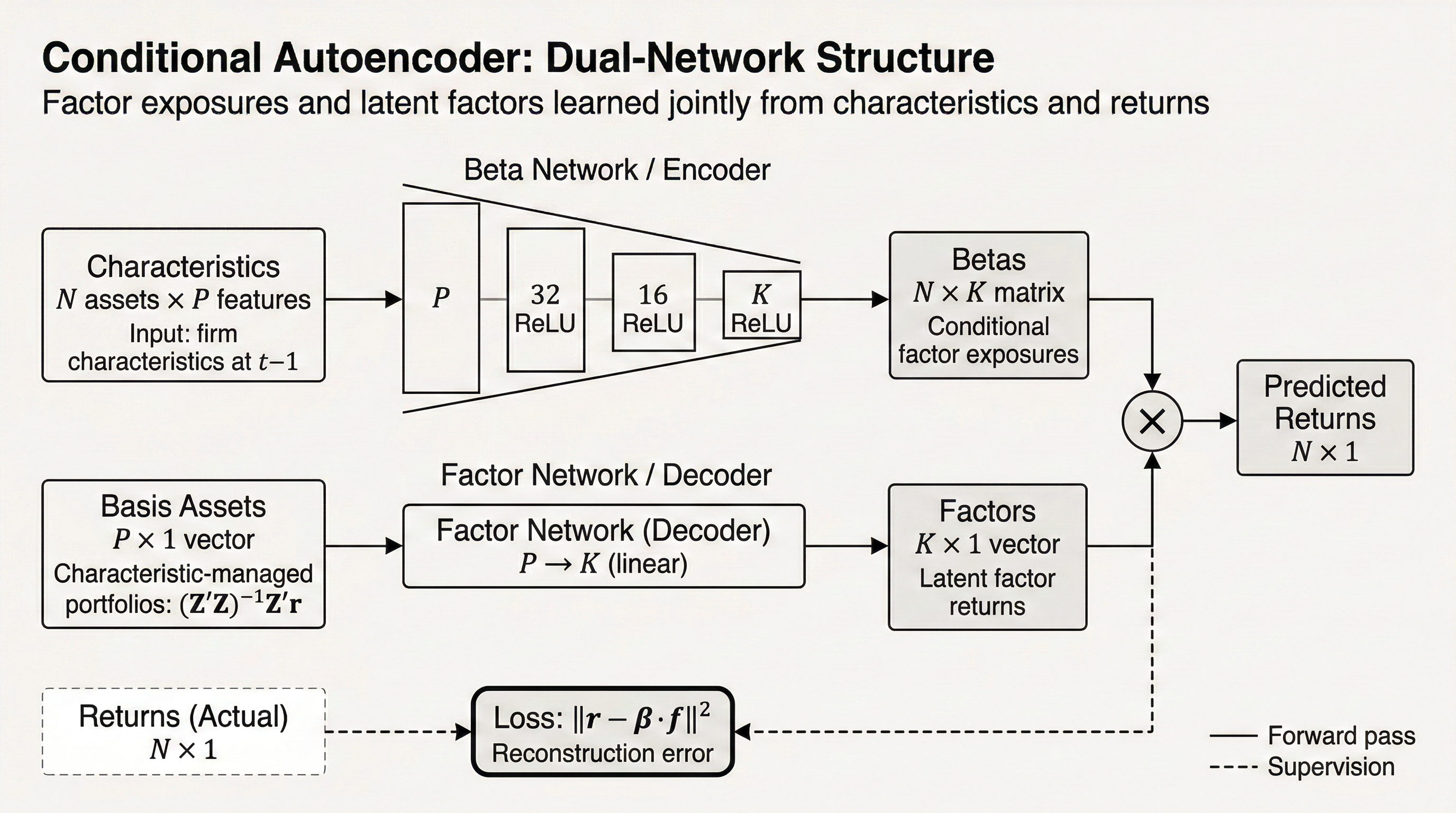
The implementable return forecast is still a two-step object:
Current implementation features:
- configurable hidden units
- checkpoint-aware training
- optional ensemble averaging across saved checkpoints
- classification mode that still keeps factor construction tied to continuous returns
Checkpoint selection changes the extracted structural state. If you pass
checkpoint=10, the betas and factor history come from the checkpoint saved at epoch 10,
not from the final training epoch.
This is the right way to think about the model:
CAEModelis a nonlinear extension of IPCA- the fitted return uses realized latent factor returns
- the tradeable forecast replaces those realized factor returns with an ex ante premium estimate
That is exactly why CAEModel lives naturally inside
LatentFactorForecastPipeline rather than exposing a monolithic end-to-end return-prediction
API.
Persistent Vs Ragged
The split between panel and cross-sectional models is intentional.
Persistent-panel family
PCAModelRPPCAModel
Ragged cross-sectional family
IPCAModelCAEModel
This is not an implementation detail. It reflects the actual assumptions the models need.
If entity identity is unstable, use IPCAModel or CAEModel, not PCAModel or
RPPCAModel.
Recommended Defaults
Simple baseline
PCAModelorIPCAModelExpandingMeanFactorForecasterBetaLambdaMapper
Pricing-aware linear baseline
RPPCAModelExpandingMeanFactorForecasterBetaLambdaMapper
Nonlinear latent-factor baseline
CAEModelExpandingMeanFactorForecasterBetaLambdaMapper
Better-than-mean factor forecasting
Swap in:
AR1FactorForecasterEWMABaseFactorForecaster
without changing the structural model.