Stochastic Discount Factor
StochasticDiscountFactorModel is a separate model family because the native object is not
a latent factor with a premium forecast. The native object is a weight-based pricing-kernel
proxy.
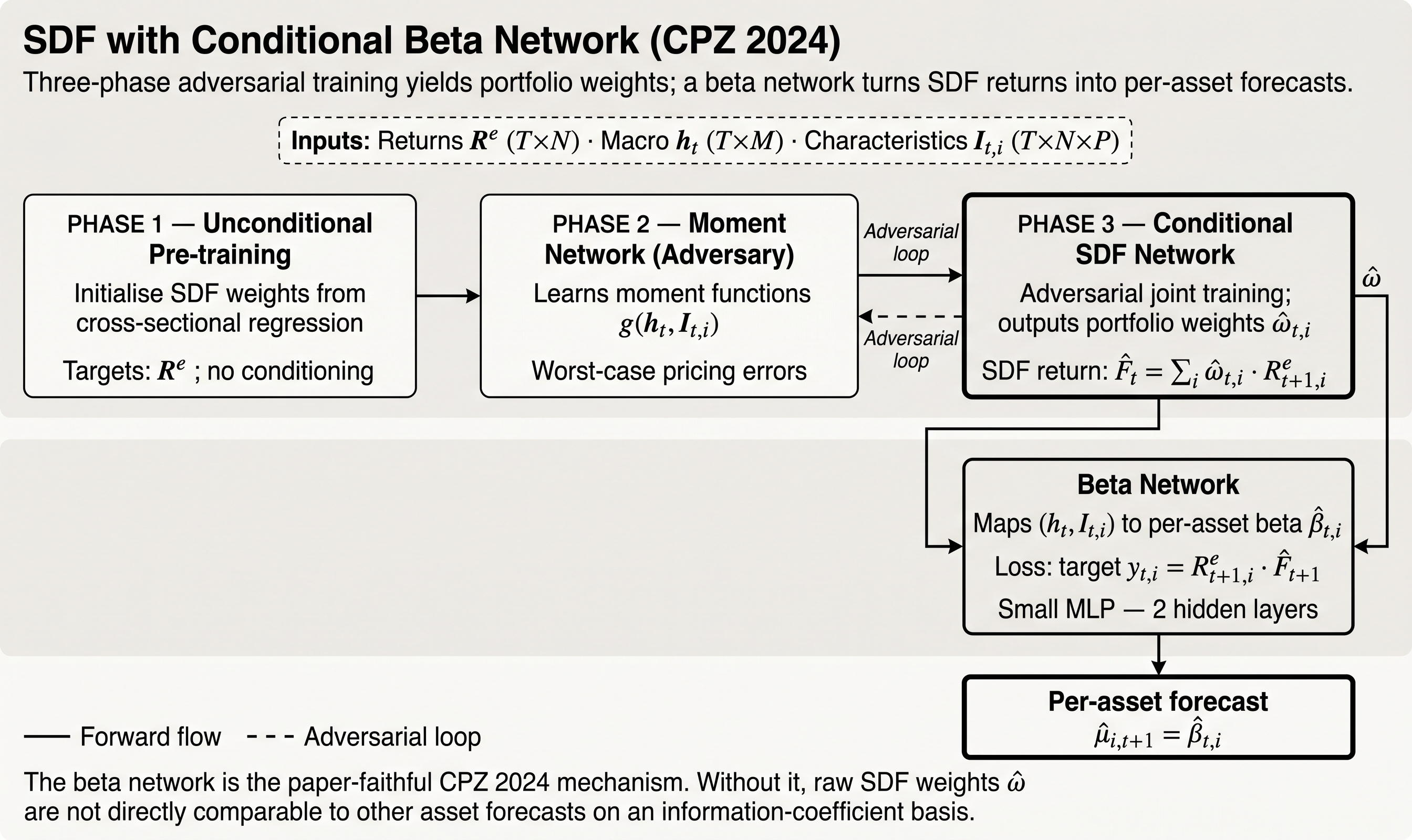
The implementation follows the phase-aware adversarial design of Chen, Pelger, and Zhu (2021): learn a pricing kernel that is disciplined by the most informative test-asset moments rather than only by reconstruction or covariance fit.
What The Model Estimates
The model is built around a no-arbitrage objective and returns:
asset_weights- optional realized
sdf_values - checkpoint-aware phase history
The public extracted state is:
StochasticDiscountFactorState
| Input contract | Native output | Primary use | Secondary mapping |
|---|---|---|---|
CrossSectionBatch |
StochasticDiscountFactorState |
SDF weights and pricing-kernel series | optional expected-return projection |
returns are required for fitting. characteristics describe the cross-section used by the
weight network, and context_features can provide date-level state such as macro or market
features.
Why It Is Separate From Latent Factors
Latent-factor models estimate:
- exposures
- factor realizations
- then expected returns through
beta × premium
The stochastic discount factor family instead estimates a traded pricing object directly. It is closer to:
- a weight-learning model
- a no-arbitrage estimator
- a direct portfolio construction mechanism
That is why it lives under:
ml4t.models.stochastic_discount_factor
instead of under latent_factors.
Training Phases
The model is phase-aware:
- unconditional SDF training
- moment network fitting
- conditional SDF refinement
Key config fields:
n_epochs_uncn_epochs_momentn_epochs_condcheckpoint_epochsdefault_checkpoint
For the beta-head side:
beta_n_epochsbeta_checkpoint_epochsbeta_default_checkpoint
Native Output
The native output mode is:
weights
That is enforced by the current model implementation. If you want expected-return-style projections, use an explicit downstream mapper rather than treating expected returns as the primary estimation target.
Optional Return Mapping
Current helpers include:
LinearStochasticDiscountFactorReturnMapperStochasticDiscountFactorBetaNetworkHead
These are downstream transformations. They do not change the fact that the core estimator is weight-native.
The linear mapper is a transparent baseline. The beta-network head is the flexible option when a nonlinear relation between SDF weights, characteristics, and return projections is useful for comparison or downstream ranking.
The beta-network head is useful when you need an expected-return-like object for comparison with latent-factor studies, ranking experiments, or downstream backtests that expect asset predictions. It should still be documented as a secondary mapping, not as the primary SDF target.
Typical Workflow
from ml4t.models import (
    CrossSectionBatch,
    StochasticDiscountFactorConfig,
    StochasticDiscountFactorModel,
)

model = StochasticDiscountFactorModel(
    StochasticDiscountFactorConfig(
        checkpoint_epochs=(256, 512, 768, 1024),
        default_checkpoint=("conditional", 1024),
    )
)

fit_summary = model.fit(batch)
state = model.extract(batch)
Practical Interpretation
There are two common uses:
1. Trade The Weight Output Directly
Use the extracted asset weights as a cross-sectional allocation signal, subject to:
- leverage normalization
- caps
- liquidity filters
- turnover controls
2. Use A Beta-Or Return-Projection Head
If you need asset-level expected-return-like quantities for a downstream ranking or comparison study, use an explicit projection helper and document that it is a secondary object.
Checkpoints
Because the structural horizon is long, this family should usually use:
- explicit sparse
checkpoint_epochs
rather than dense interval checkpointing.
That keeps:
- extraction cost manageable
- beta-head retraining manageable
- model provenance easier to interpret
For that reason, the recommended default is sparse explicit checkpoint_epochs, not dense
interval checkpointing.